
Historical Document (1918)
This article presents the complete text of Ball Bearings for Paper and Pulp Mill Machinery, published in 1918 by SKF Ball Bearing Co., Hartford, Connecticut. One of the earliest industry-specific ball bearing application guides ever published, it documents how SKF pioneered the replacement of plain bearings in the paper making industry — a transformation still echoed in modern industrial bearing applications.
Ball Bearings for Paper and Pulp Mill Machinery
SKF Ball Bearing Co., Hartford, Connecticut
Copyright 1918
Six years after ball bearings were first introduced on paper making machinery in America, SKF publishes this guide documenting their proven advantages: dramatically reduced power consumption, elimination of bearing heating problems, and greatly extended felt and wire life.
SKF Ball Bearing Co. title page
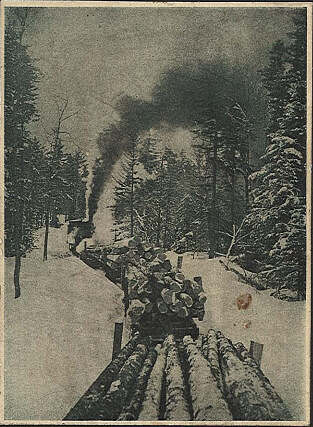
SKF Ball Bearings for Paper and Pulp Mill Machinery — full title page
Foreword
Six years ago ball bearings on paper making machinery were first introduced in America. Today ball bearings are in use on practically every type of machine found in pulp and paper mills.
In the paper industry SKF was the pioneer ball bearing; today all others are judged by it. Its success has been marked; in fact SKF is the standard on many machines today.
This book is written with a view to showing the numerous purposes for which SKF is now used in the pulp and paper industry. It is intended to show pulp and paper mills the advantages of machines SKF equipped.
SKF — The Reliable Bearing
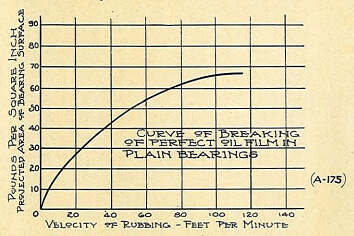
Plain bearing load/speed limit curve. Ball bearings are not limited by this curve.

Where plain bearings need 50 HP, SKF needs only 6 HP
In a continuous process like paper making it is absolutely necessary to have reliable bearings. A bearing failure in any of the machines means a shutdown with huge waste and the delay and trouble of starting up again.
SKF have been proven reliable in actual service. Not only have they proven far more reliable than any other type of bearing, but also more economical to use. In considering the change which has taken place in substituting ball bearings for plain bearings on paper machinery, the question that naturally suggests itself is, "Why has it been advisable to make these changes?" The primary reason is that ball bearings solve the lubrication problem always present with plain bearings. The successful operation of plain bearings depends upon the maintenance of a perfect film of oil between the shaft and the bearing lining. When this oil film is broken, the metal surfaces come in contact, and friction, heat and wear result.
Contrasted with this condition, ball bearings do not depend upon a film of oil to keep the bearing surfaces apart. The main purpose of the lubricant is to preserve the highly finished surfaces of the balls and races. The life of a ball bearing is dependent upon such protection.
The internal action of a ball bearing is different from that of a plain bearing. The surfaces are in rolling contact instead of rubbing contact. The lowest coefficient of friction of well lubricated plain bearings is about .025. SKF Ball Bearings have a coefficient of friction of approximately .003. As an illustration, a nest of dryers that requires 50 horse power to overcome the friction of well lubricated plain bearings would require only 6 horse power when mounted on SKF Ball Bearings. To this must be added the enormous starting effort due to the setting of plain bearings. Ball bearings have no such additional load.
The Construction of SKF
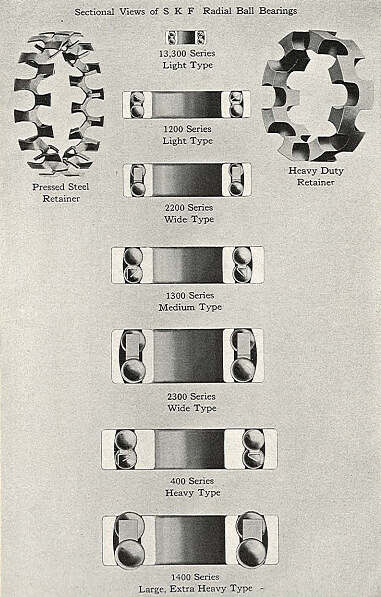
Sectional views of SKF radial ball bearing showing self-aligning feature
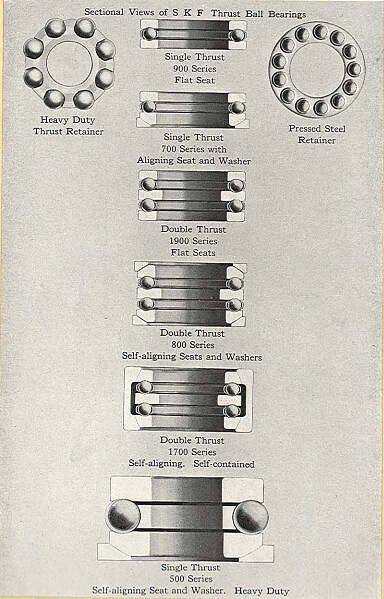
Sectional views of SKF thrust ball bearings — single and double thrust types
The SKF Radial Ball Bearing consists of an outer ball race, an inner ball race, two rows of balls, and a retainer. The SKF inner race contains two grooves in which the balls travel. These grooves are ground to a radius slightly larger than the radius of the balls. The inner surface of the outer race is spherically ground so that all points on this surface are equal distance from the center of rotation of the bearing.
Inner race, balls and retainer are free to turn in any position in the outer race. This is the SKF feature of self-alignment possessed by no other bearing. It absolutely prevents binding due to bending of the shaft or slight errors in machining. The two rows of balls are held and spaced by a retainer. The SKF retainer has no rivets, screws or other devices which can become loose.
To take thrust there is the SKF Thrust Bearing. This is made in a number of types: single or double thrust with flat seat, single or double thrust with aligning seat, and the self-contained self-aligning double thrust bearing, another exclusive SKF feature.
Care of SKF Ball Bearings
Many people believe ball bearings are delicate and require a great deal of care. This is not so. SKF Ball Bearings are much more rugged and require less attention than plain bearings. However, ball bearings are a different type of bearing and therefore require different care.
In the first place water must be excluded from ball bearings. To do this the SKF Engineering Staff has developed waterproof housings, in co-operation with various prominent builders of paper and pulp mill machinery. These housings represent the approved design and will exclude water perfectly.
The second point to remember is lubrication. SKF Ball Bearings do not need to be lubricated nearly as often as plain bearings because their housings are oil tight. The oil cannot leak out. Experience has shown that SKF Ball Bearings use about one-tenth as much lubricant as plain bearings; this lubricant should be given them once every 9 to 12 weeks.
The lubricant used should be only the best oil or grease and should be neutral. That is, it must contain no free acid or alkali either originally or through deterioration. When renewing lubricant, the bearing and housing should first be thoroughly cleaned with gasoline or kerosene. The new lubricant should then be filled into the housing; do not allow the bearing to be without lubricant even when it is not running.
Barkers
Due to the unusually heavy service and frequent neglect that barkers must stand, it is of first importance to have them as rugged and foolproof as possible. The SKF Ball Bearing saves both trouble and attention. Made of the very finest steel it is practically proof against wear.
Barkers equipped with SKF are free from delay due to hot bearings. There can be no trouble due to oil leaking out and leaving the bearing dry. SKF Ball Bearings are surrounded by a large chamber which holds enough lubricant for several months.
Another feature of SKF equipped barkers is that they save power. The friction of plain bearings is eliminated. In the disc type of barker the SKF Ball Bearings are located in the main journal boxes of the shaft carrying the disc. In the drum type barker SKF Ball Bearings should be in the carrier rolls supporting the drum.
Pulp Grinders
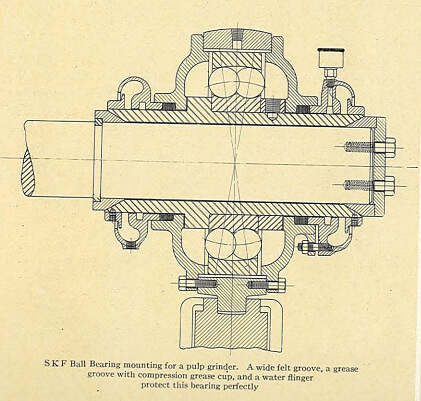
SKF ball bearing mounting for a pulp grinder with waterproof housing
The bearings of a pulp grinder are worthy of careful attention by designers. Makers who use plain bearings mount them in so-called self-aligning boxes and provide water cooling to reduce heating. Very often wood is used as the bearing lining because plain bearings wear so rapidly and wood is easier to replace. Every attention is given to repair after wear, but seemingly little time has been spent in finding the proper bearing — one which will resist wear and therefore avoid all the trouble now so common.
The SKF Ball Bearing is such a bearing. Its races and balls of hardened high carbon chrome steel do not wear. The rolling of the balls on the races prevents friction and heating; and the lubricant constantly circulates as the bearing revolves.
By using special pillow blocks with the proper SKF Bearings, results can be obtained far beyond any given by the plain bearing. First, SKF Ball Bearings eliminate the frequent replacements of the bearing lining. Second, they provide a bearing that is self-aligning in itself without the use of any self-aligning box or other device. Third, SKF Ball Bearings will save a large part of the power wasted by plain bearings. Fourth, they will show a marked increase in production.
Wet Machines
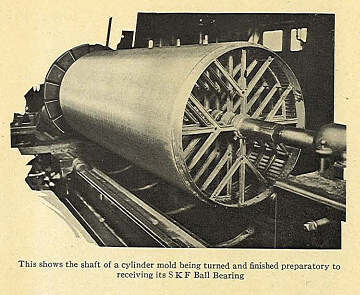
Cylinder mold shaft being turned for SKF bearing installation
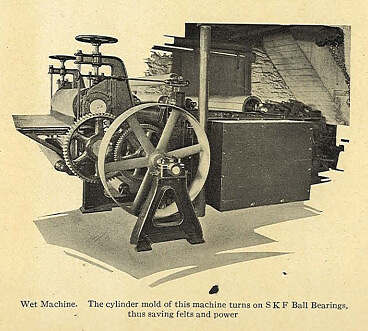
Wet machine equipped with SKF ball bearings on cylinder mold
SKF Ball Bearings have proved by actual dollars saved that they can be used to great advantage on wet machines. Cylinder mold and couch roll are turned by the pull of the felt alone. When they are mounted on plain bearings the pull on the felt is far too great. The unnecessary friction due to the plain bearings puts a heavy extra load on the felt and this tends to pull the felt apart and produce wear. Felts wear out long before they should. The same is true of the cylinder mold wire face.
There is no reason why both felt and wire face cloth should not last twice as long as they ordinarily do. The felts on SKF equipped machines do last much longer. SKF Bearings eliminate all the needless friction and so remove all unnecessary strain from the felts. The cylinder molds also last much longer when the bearings are SKF. When the couch roll is raised the force of the water from the shower pipes is enough to turn an SKF equipped cylinder mold. This shows how easy running they are.
Power saving is another feature not to be overlooked in SKF equipped wet machines. It certainly is useless to waste power when by using SKF Ball Bearings it can be saved.
The Winestock De-Fibering and De-Inking Machine
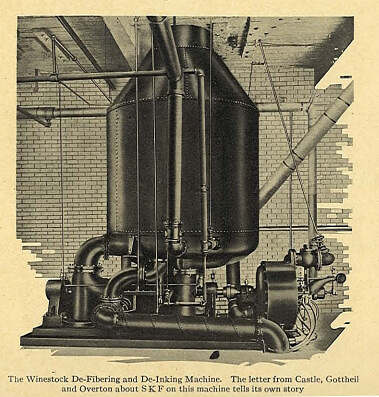
The Winestock de-fibering and de-inking machine with SKF bearings
This machine has been arousing great interest in the paper trade. It is designed to remove ink and color from waste paper, at the same time defibering the paper. It separates ink from fiber and ensures a brighter pulp. This machine is SKF equipped.
The shaft runs at a speed ranging from 1800 to 2300 r.p.m. and as the propellers on the shaft are the means by which the waste papers are broken up into fiber, there is considerable strain on the shaft and bearings, especially during the loading process. Excellent results have been obtained from SKF bearings and they are used in all machines being built.
The success of this machine has been phenomenal and SKF has played its part. By eliminating all worry that plain bearings would give, SKF has helped materially. The SKF 1700 series self-contained, self-aligning double thrust bearing is used in combination with the SKF self-aligning radial bearing. The success and satisfaction obtained with both types of bearings proves that SKF Ball Bearings, both radial and thrust, are excellently suited to this severe and continuous service.
We decided to use your bearings upon the recommendation of Messrs. E. D. Jones and Sons Co., who built the machines for us, and we realized the necessity of having the most reliable bearings we could get. The shaft whereon we use your bearings runs at a speed ranging from 1800 to 2300 r.p.m. and as the propellers on the shaft are the means by which we break up into fiber the waste papers there is considerable strain on the shaft and bearings. Thus far we have obtained excellent results from your bearings and are using the same in all machines we are building.Frank C. Overton, Castle, Gottheil & Overton (Winestock machine sales)
Jordan Engines
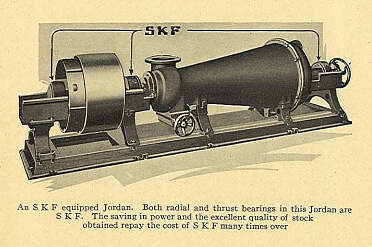
An SKF equipped Jordan engine
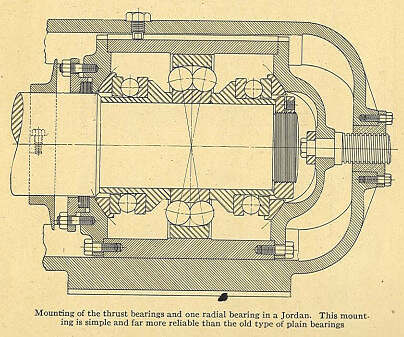
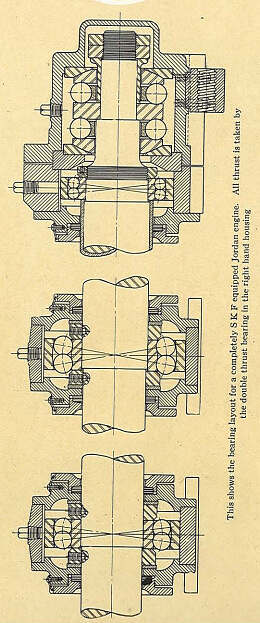
Mounting of thrust bearings on Jordan engine
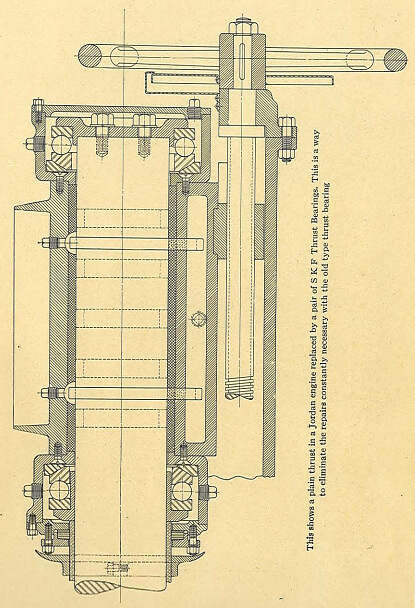
Plain thrust bearing for comparison with SKF
Jordan engines with their high speeds and heavy power consumption have afforded a good opportunity to prove the value of SKF Ball Bearings. After a number of years of service both users and manufacturers report results that are extremely satisfactory.
Tests show the advantages of SKF equipped Jordans over the old style Jordan with plain or babbitted bearings. Plain bearing Jordans use about 30% more power than SKF equipped Jordans. At the same time SKF equipped Jordans run about 40% faster. Results have shown that a great increase can be made in the stock fed to SKF equipped Jordans.
SKF Ball Bearings hold the plug absolutely in the center of the shell. There is no wear, no dropping of the plug; and this naturally means a very uniform stock of great fineness. In plain bearing Jordans the bearing wear allows the plug to drop and the result is often poor stock. SKF eliminates this.
SKF Thrust Bearings have proven their worth both in new Jordans and as a replacement for worn thrusts in old Jordans. The fact that they are of hardened steel prevents the wear so common in bronze thrust bearings.
Fourdriniers
SKF bearing layout for Fourdrinier table rolls
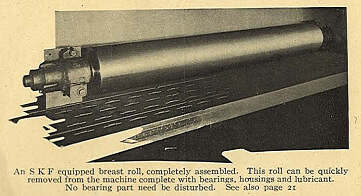
An SKF equipped Fourdrinier machine
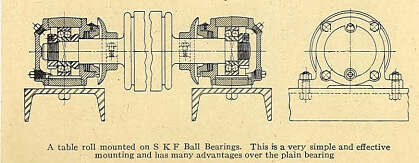
A table roll mounted on SKF ball bearings
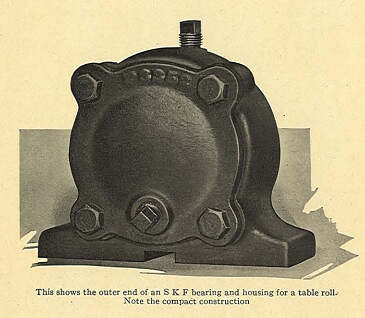
Outer end of table roll bearing assembly
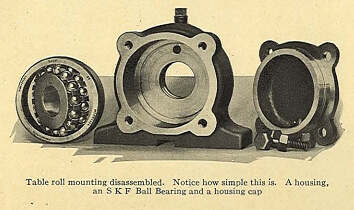
Table roll mounting disassembled
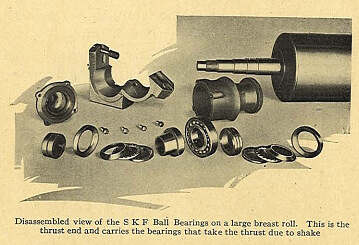
Disassembled view of SKF ball bearings
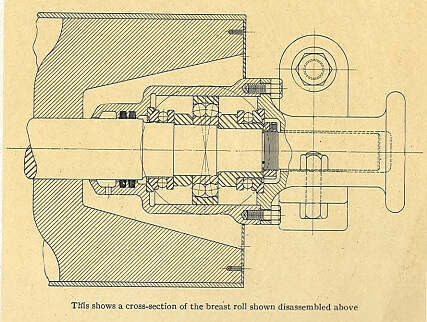
Cross section of SKF bearing in housing
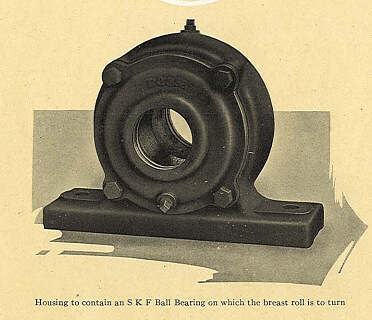
This section deals only with the Fourdrinier part. Press rolls, dryers and so on will be taken up later under their respective headings. The application of SKF to Fourdriniers has met with unqualified success. By mounting breast rolls, table rolls, wire rolls, and couch rolls on SKF Ball Bearings two great things have been accomplished. First an enormous amount of friction has been eliminated and power saved. Second, the greater part of the wear on the wire has been eliminated.
We must bear in mind that table rolls and wire rolls are turned by the pull of the wire only. If these rolls have the least tendency to stick there is a heavy drag on the wire and of course the result is wear and wasted power. By equipping these rolls with SKF Ball Bearings they become so easy running that the merest touch will turn them.
A test run with table rolls for a 202-inch Fourdrinier news machine showed some surprising results. A table roll mounted on SKF took only one ounce, tied to a string and wrapped around the roll, to make it turn. A similar table roll mounted on plain bearings needed seven times this weight before it moved.
Flat spots on table rolls are the result of stiff, binding plain bearings. If such rolls are used they either revolve with a jerky motion or they do not revolve at all. Such irregular motion disturbs the stock as it forms on the wire, and frequently causes the stock to spatter, resulting in imperfections causing the paper to tear and necessitating the stopping of the entire machine.
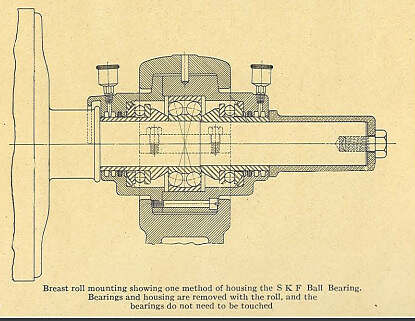
Further great advantages are gained by mounting the breast roll and couch rolls on SKF. There is a very considerable power saving. Then, there is no wear. SKF Ball Bearings, since they are of finest hardened steel, do not wear or drop out of alignment.
It is important to have breast roll and under couch roll revolve at the same speed, so there is no pull on the wire. For this reason SKF Ball Bearings are ideal because they permit the rolls to revolve with absolute freedom. This greatly increases the life of the wire.
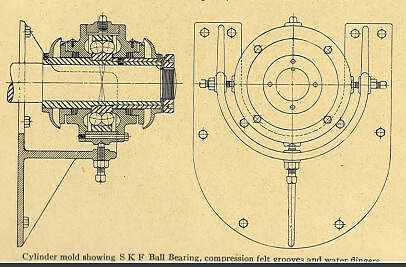
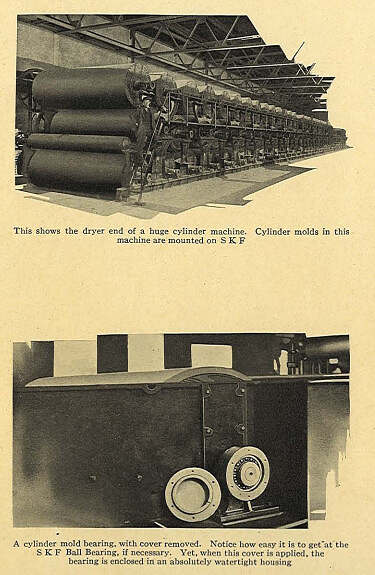
SKF Ball Bearings are mounted in a waterproof housing. By means of grease grooves, felt grooves and flingers, water is kept away from the bearing. The housing keeps water out and oil in. It protects the bearing from injury and keeps it always supplied with lubricant.
The Cylinder Machine
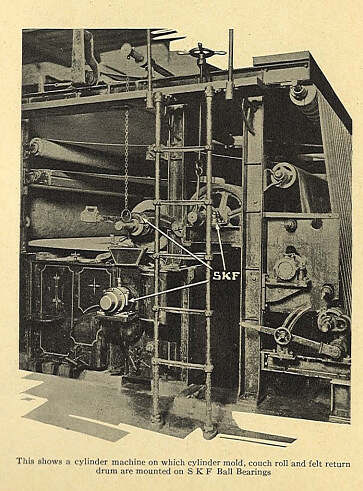
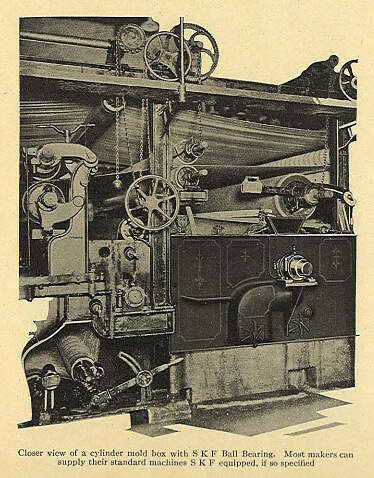
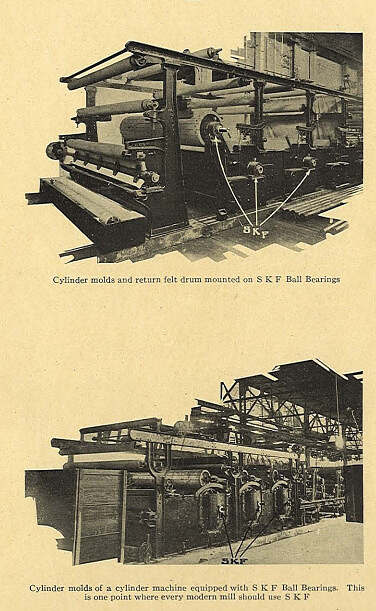
The results obtained by equipping the cylinder molds and couch rolls of a cylinder machine with SKF are very much the same as those obtained in a wet machine. Users have found that the life of the felt is greatly increased; 50% added to the life of felts through SKF Ball Bearings is not unusual. Felts are expensive; by investing a small sum in SKF Ball Bearings users have profited many times this amount by saving in felts alone.
The power saved by eliminating useless bearing friction is another large item which makes SKF a dividend paying investment. Many letters have been sent saying that greatly reduced power bills or coal bills proved that SKF made a large saving in power.
Naturally by eliminating needless friction the drag on the cylinder mold is greatly reduced and a corresponding saving is made. The wire face is not subjected to needless pulls to make it turn. Wear is reduced to the minimum and consequently the life of the cylinder mold is lengthened.
The felt return drum is another place where SKF have been successfully employed. This roll takes the entire pull of the felt and relieves the couch rolls of unnecessary strains. It must be easy turning and respond to every pull so that no power is wasted and no extra wear placed on the felt.
Squeeze rolls are subjected to heavy pressure and the bearings are exposed to water unless properly protected. Here is a logical place for SKF. With its high load carrying capacity and its oil tight waterproof housing, the SKF Ball Bearing will eliminate wear and wasted power at this point.
We have used your SKF Ball Bearings, both the heavy and light types, on several parts of paper making equipment with excellent results. We have found that in the two or three instances where trouble has occurred, this trouble was always due to neglect, especially when it came to lubricating. We have made some installations which have been in service over two years.William G. Webb, Union Machine Co.
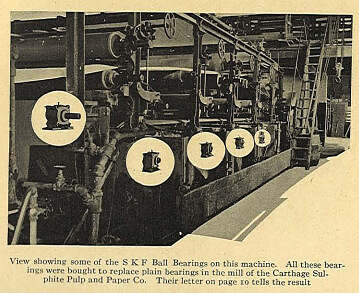
We are pleased to advise we first tried a set of your SKF Ball Bearings on one of the cylinder molds on our Black-Clawson machine and the bearings pleased us so well, we immediately decided to similarly equip the remaining three cylinders. We have found that these bearings have increased the life of the felts on this machine fully 50%. There is also a considerable saving in power. When the writer asked our superintendent today what he thought of these bearings, he replied, "I cannot say enough for them."Guy C. Jones, Secretary, Carthage Sulfite Pulp & Paper Company
Press Rolls
A bearing for press roll work must be housed waterproof and must also be able to withstand heavy pressure. SKF Ball Bearings have these features. On both press rolls and primary or baby press rolls SKF has shown excellent results. The steel used in SKF Ball Bearings can stand tremendous loads. A single ball made of this material one inch in diameter will stand a load of over fifty tons before breaking. So it is plain that SKF Bearings are ideal for heavy loads.
On upper press rolls SKF give particularly good service. These rolls must turn freely so that the sheet may pass through evenly over its full width. When plain bearings are used one bearing always takes more power than the other, causing the paper to lag on one side. When SKF Ball Bearings are used these rolls turn with perfect freedom and there is no drag or lag.
The waterproof feature, combined with reduced bearing friction and elimination of lubrication troubles, gives paper manufacturers means of increasing the life of the felt, improving the quality of the paper and saving power.
Dryer Rolls
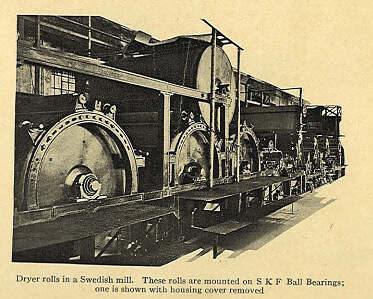
The service on dryer rolls is unusually heavy. Due to the great weight of the dryers it was long supposed that the plain bearing was the only bearing which could stand the work. This theory, however, has been exploded. One of the largest paper mills in the East has equipped some dryer cylinders with SKF Ball Bearings. These have been in operation since early in 1916 with the most satisfactory results.
The dryer rolls each weigh 22 tons and the diameter of the journal is over 7 inches. Each cylinder is carried by two SKF Ball Bearings. The power necessary to run these cylinders is greatly reduced and the reduction on starting load is even greater.
It is clear that the plain bearings on a battery of dryers will easily be squeezed dry and make starting loads abnormally high. Furthermore the fact that the dryer cans are filled with steam makes it exceedingly difficult to tell when a plain bearing is heating due to being dry. SKF Ball Bearings eliminate this trouble. They are specially fitted to allow for high steam temperatures.
In addition to the large dryer rolls, SKF Ball Bearings have also been applied to felt dryers, with signal success. One company has found that by equipping their felt dryers with SKF they can use a felt six months where formerly it lasted only two to two and a half months. In addition, no auxiliary drive is necessary because the rolls are so easy turning. The rolls turn by the pull of the felt alone.
A calender dryer was made by one of the leading builders and was equipped with SKF Ball Bearings. The weight of these rolls was 50,000 pounds each and the arrangement was such that the load per set of bearings was 100,000 pounds, 50 tons. The results were exceedingly satisfactory. The calender dryer was run by about 10 horse power. The rolls were so free-running that a mere push of the hands was enough to start one roll when released from contact with the other.
For the past five years we have used SKF Ball Bearings on our Paper Machines with very satisfactory results. Enclosed in their Waterproof Housings we consider them particularly adapted for Cylinder Molds. In this connection they have proven great savers of felts as well as materially reducing the power consumed. SKF Ball Bearings always have our recommendation for this class of work.Edw. T. McNally, Manager, Emerson Manufacturing Co.
Calenders
A desirable place for the application of ball bearings is on the intermediate rolls of calenders. The bearings of these rolls must be exceedingly accurate to hold the axes of all rolls exactly parallel. This is to prevent calender cuts. Where the load is not excessive, one bearing is used on each end of the roll. This makes a mounting that is self-aligning in itself and makes parallel adjustment of rolls easy.
The enormous pressure on calender rolls will squeeze out all lubricant and wear the best babbitt or bronze. When SKF are used on the intermediate rolls, rubbing is eliminated and the rolls can always be held absolutely in the desired position. When SKF equipped intermediate rolls are removed, the housing, bearing and lubricant come with them. So the bearing need never be disturbed on the shaft and it will always be protected by oil even when the roll is dismounted.
Winders, Slitters and Rewinders
It is well to have these machines as easy running as possible to avoid all unnecessary power waste. SKF Ball Bearings will do this by removing the friction of plain bearings. In addition SKF Ball Bearings need very little attention — only a replenishing of lubricant once every three or four months.
In winders and rewinders the weight of the stock as it is reeled up will often cause the winding shafts to deflect or spring. This deflection may be only very slight, but no shaft is so rigid that it will not deflect under heavy load. This will cause the shaft to bind if carried on plain bearings and naturally the bearing will score and wear.
SKF Ball Bearings, on the other hand, will carry such a shaft perfectly because they are self-aligning and compensate for the bending and springing of the shaft.
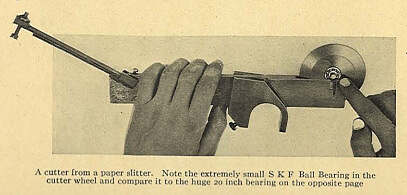
On slitter cutters, SKF prevent the sticking of the circular cutter by providing a free-turning, non-binding bearing. Plain bearings in cutters will heat and bind. This dulls the cutter rapidly and prevents a smooth clean cut. The improvement SKF will make on this type of machinery is not to be underestimated.
We have used the SKF Ball Bearing for a number of years with very satisfactory results. The Cameron Slitter must be free-running and durable as well as free from wear and trouble. In order to obtain this, we have equipped each Cameron Cutter with an SKF Ball Bearing and have found that this self-aligning ball bearing meets our requirements in every respect. The quality of the Cameron Slitting and Rewinding Machine demands that every part entering into its construction must be of the highest quality. In the SKF we have found a bearing which fulfills these requirements.James A. Cameron, President, The Cameron Machine Company
We have used a good many thousands of dollars worth of your SKF Ball Bearings on the paper making machinery that we manufacture, and the results that this type of bearing have given, have been — in the main — very satisfactory. We believe that these SKF Bearings are particularly desirable on felt dryers, thereby enabling the dryers to be readily driven by the felt alone without the use of any gear. We believe that our Company was the first paper machinery manufacturing concern that ever used any of your SKF Ball Bearings, and we anticipate using them in considerable quantities on our paper machinery in the time to come.George S. Barton, Treasurer, Rice, Barton & Fales M. & I. Co.
We are using SKF Ball Bearings on six cylinders and drum roll on our board machine and on one cylinder and drum roll on our sulphite machine. We find that they are giving excellent service and that the life of our felts is greatly increased by their use. We do not know what saving we make in power, but are sure that this is considerable, as the increased length of the life of our felts would show. We are very glad to be able to testify to the excellence of your product.J. H. Thickens, Manager, Bathurst Lumber Company Ltd., Pulp and Paper Division
Motors
Motors in paper mills are very generally left to take care of themselves. The current is turned on; the motors run; nobody pays any attention to them until a hot box compels it. Then there is a shutdown, followed by expensive repair work and costly delay. All this can be very easily avoided by the use of SKF Ball Bearings. They take care of the two points vital to motor life: lubrication and freedom from wear.
SKF Ball Bearings are housed oil tight. No oil can leak out and therefore a supply of oil will last months in a ball bearing motor. It is only necessary to lubricate SKF equipped motors once every four to six months.
The very finest steel obtainable plus painstaking care in heat treating and grinding make SKF Ball Bearings the most efficient guardians against wear that can be used on any motor. Several large motor manufacturers have standardized on SKF and use only SKF on all their motors.
All motors in paper or pulp mills need SKF on account of the heavy work required of them.
Pumps and Auxiliaries
There are certain auxiliaries used in paper and pulp mills which are also used in other fields and on which SKF have been thoroughly proven. One of these is the electric motor which has just been described. Another is the centrifugal pump.
The main trouble of this type of pump is bearing heating and wear. Naturally where there is heating there is also a large power loss. These troubles are eliminated by the use of SKF Radial and SKF Thrust Bearings.
Many makers of fans and blowers, among them the largest in the country, have long been equipping their product with SKF. Trucks, hoists, trolleys, cranes and all other auxiliary equipment can be bought SKF equipped. Various manufacturers of such machinery have so designed their product. And it is a significant fact that in each instance these makers who use SKF are the acknowledged leaders in their field.
Transmission
SKF transmission bearing assembly — tapered inner race mounting
SKF transmission pillow block in drop hanger configuration
SKF transmission catalog page 28
SKF transmission catalog page 29
SKF transmission catalog page 30
SKF transmission catalog page 31
SKF transmission catalog page 32
SKF transmission catalog page 33
SKF transmission catalog page 34
SKF transmission catalog page 35
SKF transmission catalog page 36
SKF Transmission equipment is the SKF Self-Aligning Ball Bearing adapted to transmission work. The hole in the inner race of the bearing is tapered. In mounting the bearing on a lineshaft a tapered split sleeve is first slipped on the shaft; then the bearing is slid into place on this sleeve. A locknut forces the bearing tightly on the sleeve and holds the sleeve firmly to the shaft. In this way no machining of the shaft is necessary.
SKF Ball Bearings are a great step in advance of any other bearings used on paper mill drives. They are extremely durable and economical. They use only 20% of the lubricant used by plain bearings. In addition they save from 60 to 80% of the power wasted in friction by babbitted bearings.
SKF Ball Bearings are supplied with an oil tight dustproof housing that can be mounted in drop hangers, post hangers or pedestal pillow blocks. For use in paper mills SKF Transmission equipment presents many advantages. Shafting, no matter how carefully put up, will in time pull out of line. Heavy loads, vibration, and settling of buildings will do this. The shaft will not be out of line enough to be noticeable to the eye; but even the least bit is enough to bind a plain bearing. This is just what SKF Ball Bearings prevent. They are self-aligning and they compensate for misalignment.
Then too there are often heavy overloads on a shaft, such as when starting up. These loads will make the shafting spring, bend and deflect. SKF Ball Bearings do not bind under these conditions as babbitt bearings do. SKF Ball Bearings pivot and yield to this springing. They turn freely in all positions.
The third advantage gained from SKF Transmission equipment is freedom from lubrication troubles. A bearing that leaks oil soon runs dry. A dry bearing heats and wears; it scores and finally you have a hot box or a seized bearing. SKF eliminates all this. The SKF Bearing is surrounded by an oil tight casing; the oil cannot possibly leak out. SKF Ball Bearings on transmission equipment need oil only once in four months.
SKF Transmission equipment is very compact. The bearing and housing are only one-half to one-third as long as a plain bearing for the same shaft size.
How to Obtain SKF
In reading this book you may have found some machine that is now giving you trouble and that can be improved by the use of SKF, or perhaps you have a special machine which you want to equip with SKF. The question is how and where can you obtain SKF, and how to apply them to your machine.
There are two ways. Every maker of paper and pulp mill machinery will supply SKF on new machines if you specify them. Practically every maker will replace plain bearings with SKF. Therefore by going to the maker of your machine you can have him supply you with SKF Ball Bearings and Housings. The bearings will be according to specifications furnished by us and the housings will be of our approved design.
Should your maker not be in a position to do this, write us. We will be glad to cooperate with you through our Engineering Department. Because of long experience they will be able to submit proper bearing recommendations which will be helpful to you.
As the use of a high quality, serviceable bearing — SKF — spreads, there will come a new era in paper making machinery. All will realize that the numerous troubles, due to plain bearings, now tolerated, can be eliminated by using SKF.
By cooperation between mill, machinery maker and SKF we hope to spread the use of SKF to every mill that needs and wants better machinery. The service and advantages gained by users of SKF Ball Bearings are so tangible that the purchasing price becomes a minor consideration.