
Radial Bearing Shaft Seals – AS and SA
AS and SA are radial oil seals for stainless steel bearing housings. They seal bearing housings against contaminants with long-lasting efficiency. There are two versions available, AS and SA. Each version has a specific design for specific applications.
The seals are made of nitrile rubber (NBR) which provides good resistance against mineral oils and greases, making them suitable for a wide range of standard industrial applications.
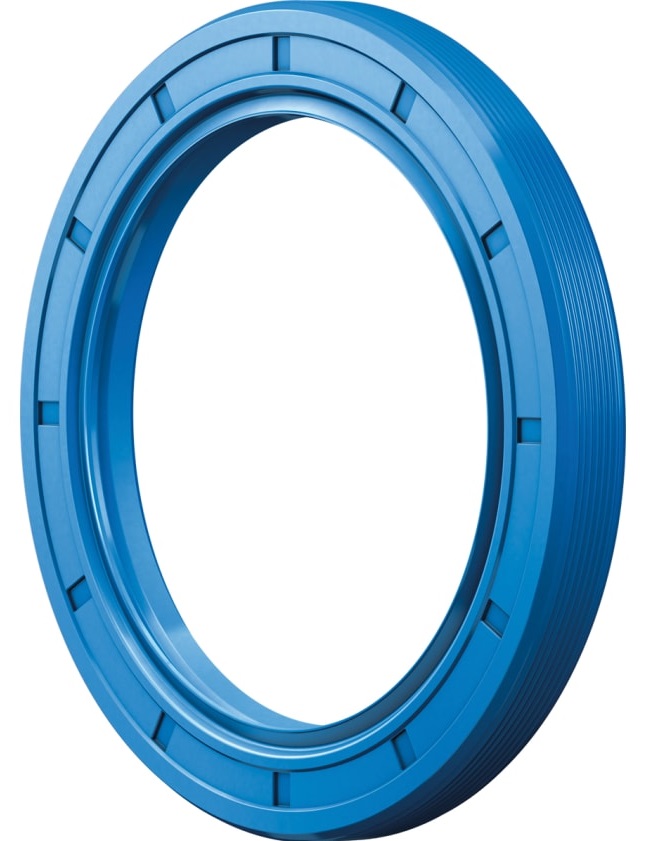
AS Seal
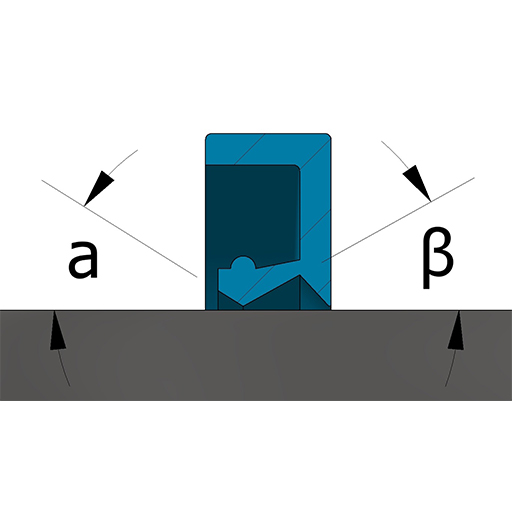
AS oil seals are designed with asymmetric lip angles. The angle α between the shaft and lip on the air side is larger than the angle β on the lubricant side. This geometry is designed to prevent contamination from entering the bearing housing while retaining lubricant inside. Normally, seals are designed with a small angle β on the lubricant side and a large angle α on the air side. This prevents lubricant from leaking out of the system. However, when grease is used, the difference in angles is less important and often reversed to provide better sealing against contaminants from outside. This is what we call the AS version.
The AS seal provides reliable sealing for bearing housings in standard to moderately contaminated environments, especially suitable for use in closed bearing assemblies such as AS / AS-VK assembly. Used on places with none abrasive surrounding. Just to close and become a maintenance free bearing unit sealed against contaminants.

Mounting tip
It is necessary that, if you do the initial greasing, to keep the cap a little bit open. To ensure that air can escape.
SA Seal
SA oil seals are designed with asymmetric lip angles as shown in the illustration. The angle α between the shaft and lip on the air side is smaller than the angle β on the lubricant side to prevent lubricant from leaking out of the system. When grease is used, the difference in angles is less important and often reversed to provide better sealing against contaminants from outside. We call this seal version SA. Leakage is less of a concern here due to the consistency of grease, which prevents excessive loss of lubricant. Therefore the main purpose of the grease seal is to keep contaminants out.
To improve bearing life by the correct use of bearing shaft seals, it is recommended to use an automatic lubricator or lubricate regularly. Only a small quantity of grease is necessary when slowly flushed into the bearing cavity to force dust and moisture away from the seal lips.
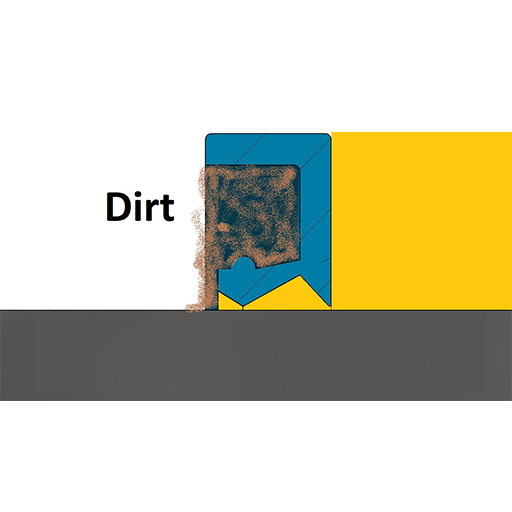
Note – SA Seal Is Not for Food Applications
The SA seal is not suitable for applications where high hygiene is demanded because the cavity in the lip can act as a chamber for collecting dirt. For high hygiene applications, use our CC design.
Not suitable for abrasive environments
The AS seal and, to a lesser extent, the SA seal are not suitable for applications where there is a risk of contamination from abrasive materials. For this type of application, use our CS design.
Grease Is a Great Help to Sealing Bearing Housings Against Contaminants
Grease can be a great help to sealing bearing housings against contaminants. The gaps between the lips of the centrifugal seal and the stator must be sealed to keep out dust and water. To improve bearing life for centrifugal bearing shaft seals, it is recommended to use an automatic lubricator or to lubricate regularly. Only a small quantity of grease is necessary when slowly flushed into the bearing cavity to force dust and moisture away from the working parts.
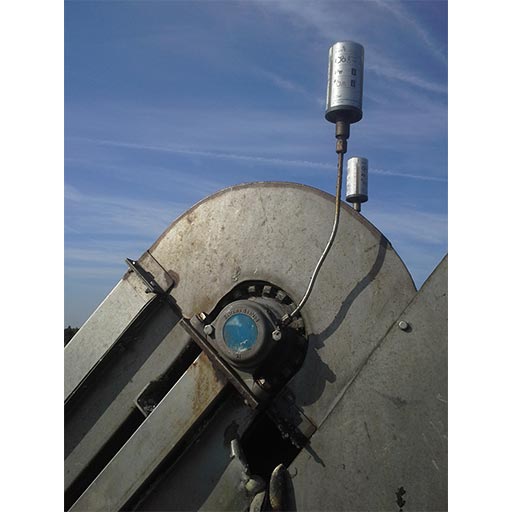
Examples of Grease Diagrams Using AS Bearing Shaft Seals
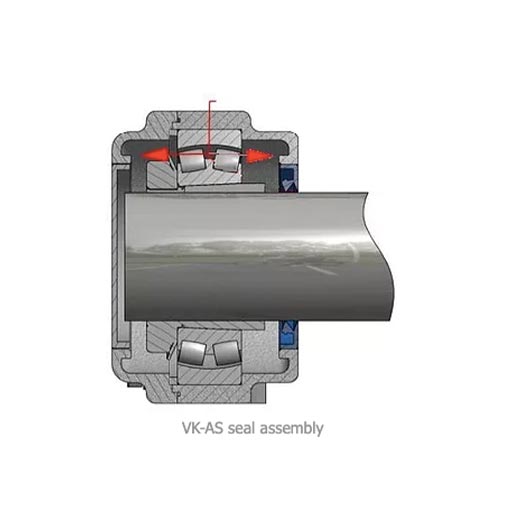
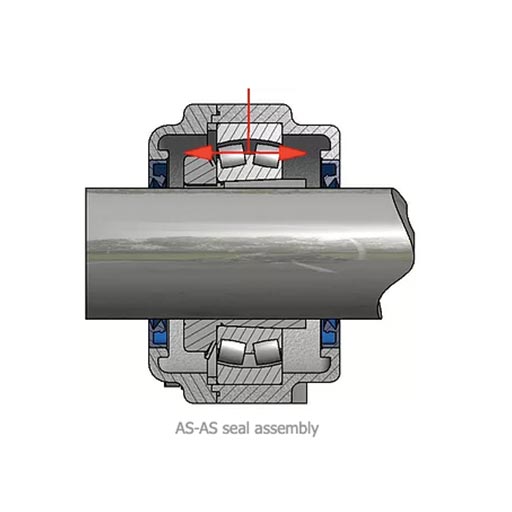
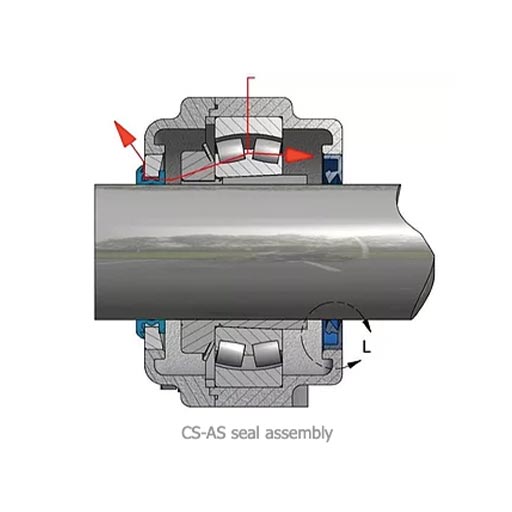
If the contamination is only on one side of the bearing unit, a seal combination can be chosen that is based on refilling the grease on this side. In this way, the contamination along with the grease shall flow away from the sealing lips. An example of such an assembly, a CS-AS combination, is shown in one of the illustrations with the path of the grease shown by the red arrows.
Important Information for Initial Greasing of Pressure-Tight Bearing Units
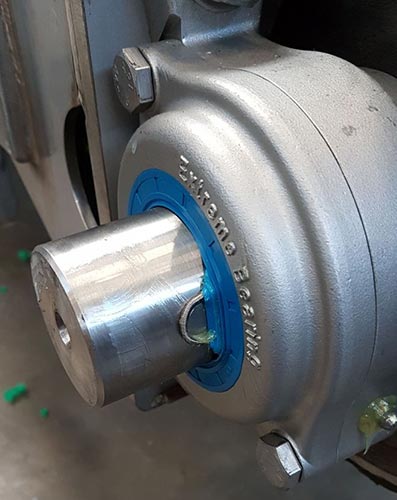
In some configurations, the bearing units from Extreme Bearing are bearing shaft seals pressure-tight. Therefore it is necessary to keep the cap a little bit open while you do the initial greasing. Otherwise problems like in the picture shown here can occur.
In addition, whenever it is necessary to add some more grease later, you should always take care not to create overpressure in the housing. The Extreme Bearing units are pressure-tight when used with the following configurations of seals: AS/AS, AS/VK, CL/CL and CL/VK.
What These Seals Resist – NBR (AS / SA / CS Seals)
The list below shows the chemicals, fluids and gases against which the NBR (nitrile rubber) sealing element of AS, SA and CS seals is reliably resistant. A check mark in a temperature column means the seal can handle that medium at that temperature. Empty cells indicate that the medium is not recommended at that temperature — pick a higher-grade seal (FKM, silicone or PTFE) instead.
Indicative values based on industry compatibility charts (Parker O-Ring Handbook, Trelleborg, ERIKS). The end user is responsible for validating suitability for their specific application — concentration, pressure, mechanical stress and exposure time matter. When in doubt, contact Extreme Bearing for a tailored recommendation.
| Chemical | 20°C / 68°F | 60°C / 140°F | 100°C / 212°F |
|---|---|---|---|
| Formaldehyde (40%) | ✓ | ||
| Ascorbic acid | ✓ | ✓ | |
| Citric acid | ✓ | ✓ | |
| Fatty acids (>C6) | ✓ | ||
| Oxalic acid | ✓ | ||
| Phthalic acid | ✓ | ||
| Stearic acid | ✓ | ✓ | |
| Tannic acid (10%) | ✓ | ✓ | |
| Tartaric acid | ✓ | ✓ | |
| Boric acid | ✓ | ✓ | |
| Carbonic acid | ✓ | ✓ | |
| Silicic acid | ✓ | ||
| Sulphites | ✓ | ✓ | |
| Ammonia, aqueous | ✓ | ||
| Caustic soda & potash | ✓ | ||
| Lime (CaO) | ✓ | ✓ | |
| Alum | ✓ | ✓ | ✓ |
| Aluminium chloride | ✓ | ✓ | |
| Aluminium sulphate | ✓ | ✓ | |
| Ammonium chloride | ✓ | ✓ | |
| Brines, saturated | ✓ | ✓ | |
| Bromide (K) solution | ✓ | ✓ | |
| Calcium chloride | ✓ | ✓ | |
| Chlorates of Na, K, Ba | ✓ | ✓ | |
| Chlorides of Na, K, Ba | ✓ | ✓ | ✓ |
| Copper salts (most) | ✓ | ✓ | |
| Ferric chloride | ✓ | ✓ | |
| Ferrous sulphate | ✓ | ✓ | |
| Lead acetate | ✓ | ||
| Mercuric chloride | ✓ | ✓ | |
| Mercury | ✓ | ✓ | ✓ |
| Nickel salts | ✓ | ✓ | |
| Nitrates of Na, K and NH3 | ✓ | ✓ | |
| Nitrite (Na) | ✓ | ✓ | |
| Silver nitrate | ✓ | ✓ | |
| Sodium carbonate | ✓ | ✓ | |
| Sodium silicate | ✓ | ✓ | |
| Sodium sulphide | ✓ | ✓ | |
| Stannic chloride | ✓ | ||
| Sulphates (Na, K, Mg, Ca) | ✓ | ✓ | |
| Zinc chloride | ✓ | ✓ | |
| Cyclohexane | ✓ | ✓ | |
| Naptha | ✓ | ✓ | |
| Petroleum spirits | ✓ | ✓ | |
| Paraffin wax | ✓ | ✓ | |
| Oils, diesel | ✓ | ✓ | |
| Oils, mineral | ✓ | ✓ | |
| Oils, vegetable and animal | ✓ | ✓ | |
| Alcohols | ✓ | ||
| Methanol | ✓ | ||
| Glycerine | ✓ | ✓ | |
| Glycols | ✓ | ✓ | |
| Glycol, ethylene | ✓ | ✓ | |
| Acetylene | ✓ | ✓ | |
| Fluorinated refrigerants | ✓ | ||
| Sulphur | ✓ | ✓ | |
| Water, distilled | ✓ | ✓ | |
| Water, soft | ✓ | ✓ | |
| Water, hard | ✓ | ✓ | |
| Sea water | ✓ | ✓ | |
| Moist air | ✓ | ✓ | |
| Beer | ✓ | ✓ | |
| Fruit juices | ✓ | ✓ | |
| Gelatine | ✓ | ✓ | |
| Meat juices | ✓ | ✓ | |
| Milk products | ✓ | ✓ | |
| Molasses | ✓ | ✓ | |
| Starch | ✓ | ✓ | |
| Sugar, syrups & jams | ✓ | ✓ | |
| Tallow | ✓ | ✓ | |
| Urea (30%) | ✓ | ✓ | |
| Yeast | ✓ | ✓ | |
| Detergents, synthetic | ✓ | ✓ | |
| Silicone fluids | ✓ | ✓ | |
| Wetting agents (<5%) | ✓ | ✓ | |
| Ethanol | ✓ | ||
| Isopropanol (IPA) | ✓ | ||
| Propylene glycol | ✓ | ✓ | |
| Water/glycol coolant | ✓ | ✓ | |
| Hydraulic fluid (HL, HLP, HM, mineral) | ✓ | ✓ | |
| Hydraulic fluid HFA (oil-in-water) | ✓ | ✓ | |
| Hydraulic fluid HFC (water-glycol) | ✓ | ✓ | |
| Brake fluid (DOT 3/4, glycol) | ✓ | ||
| Gasoline / petrol | ✓ | ||
| Kerosene | ✓ | ✓ | |
| Jet fuel (JP-4/JP-5/JP-8) | ✓ | ✓ | |
| Heating oil / fuel oil | ✓ | ✓ | |
| LPG (propane, butane) | ✓ | ✓ | |
| AdBlue (urea solution 32.5%) | ✓ | ✓ | |
| Transformer oil | ✓ | ✓ | |
| Turbine oil | ✓ | ✓ | |
| Gear oil | ✓ | ✓ | |
| ATF transmission fluid | ✓ | ✓ | |
| Silicone grease | ✓ | ✓ | |
| Lithium-soap grease | ✓ | ✓ | |
| Compressed air, dry | ✓ | ✓ | |
| Nitrogen (N2) | ✓ | ✓ | ✓ |
| Carbon dioxide (CO2) | ✓ | ✓ | |
| Hydrogen (H2) | ✓ | ✓ | |
| Helium (He) | ✓ | ✓ | ✓ |
| Argon (Ar) | ✓ | ✓ | ✓ |
| Ethylene (C2H4) | ✓ | ✓ | |
| Propylene (C3H6) | ✓ | ✓ | |
| Methane (CH4) | ✓ | ✓ | |
| Natural gas | ✓ | ✓ | |
| Carbon monoxide (CO) | ✓ | ✓ | |
| Refrigerant R22 (HCFC) | ✓ | ||
| Refrigerant R134a (HFC) | ✓ | ✓ | |
| Refrigerant R1234yf (HFO) | ✓ | ✓ | |
| Refrigerant R717 (ammonia) | ✓ | ||
| Refrigerant R744 (CO2) | ✓ | ✓ | |
| Wine | ✓ | ✓ | |
| Coffee / tea | ✓ | ✓ | |
| Vegetable juice | ✓ | ✓ | |
| CIP cleaner, alkaline (1-3%) | ✓ | ||
| Pentane | ✓ | ✓ | |
| Hexane | ✓ | ✓ | |
| Heptane | ✓ | ✓ | |
| Octane | ✓ | ✓ | |
| Isobutylene | ✓ | ||
| Butanol (n-butanol) | ✓ | ||
| n-Propanol | ✓ | ||
| Oleic acid | ✓ | ||
| Palmitic acid | ✓ | ||
| Adipic acid | ✓ | ✓ | |
| Lauric acid | ✓ | ||
| Ammonium sulphate | ✓ | ✓ | |
| Ammonium nitrate | ✓ | ✓ | |
| Copper sulphate | ✓ | ✓ | |
| Zinc sulphate | ✓ | ✓ | |
| Magnesium sulphate | ✓ | ✓ | |
| Magnesium chloride | ✓ | ✓ | |
| Barium chloride | ✓ | ✓ | |
| Potassium chloride | ✓ | ✓ | ✓ |
| Sodium thiosulphate | ✓ | ✓ | |
| Refrigerant R32 (HFC) | ✓ | ✓ | |
| Refrigerant R410A (HFC blend) | ✓ | ✓ | |
| Refrigerant R454B (HFO blend) | ✓ | ✓ | |
| Refrigerant R1234ze (HFO) | ✓ | ✓ | |
| Refrigerant R290 (propane) | ✓ | ✓ | |
| Refrigerant R600a (isobutane) | ✓ | ✓ | |
| Sulphur hexafluoride (SF6) | ✓ | ✓ | |
| Nitrous oxide (N2O) | ✓ | ✓ | |
| Olive oil | ✓ | ✓ | |
| Soybean oil | ✓ | ✓ | |
| Palm oil | ✓ | ✓ | |
| Rapeseed (canola) oil | ✓ | ✓ | |
| Fish oil | ✓ | ✓ | |
| Butter | ✓ | ✓ | |
| Cheese curds / whey | ✓ | ✓ | |
| Eggs (raw / liquid) | ✓ | ✓ | |
| Mustard | ✓ | ✓ | |
| Liquid sugar / glucose syrup | ✓ | ✓ | |
| Quaternary ammonium compounds (QACs) | ✓ | ||
| Chlorhexidine solution | ✓ | ✓ | |
| Cutting oil (water-soluble emulsion) | ✓ | ✓ | |
| Cutting oil (neat, mineral) | ✓ | ✓ | |
| HVO renewable diesel | ✓ | ✓ | |
| Marine heavy fuel oil (HFO) | ✓ | ||
| Drilling mud (water-based) | ✓ | ||
| Drilling mud (oil-based) | ✓ | ✓ | |
| Cement slurry | ✓ | ||
| Fly ash slurry | ✓ | ✓ | |
| Cyanide solution (gold mining, NaCN) | ✓ |
Service instruction
Please inform your maintenance crew about this special service operating instruction. It could be helpful to dismount the grease nipples and exchange them with a standard stainless screw, so it will be impossible to make mistakes.